Basketball teams play down to their opponents. We know that. But we've also heard that good defense leads to good offense. These are seemingly contradictory.
But they're not. Both are true. How they are both true is what is now clear.
More than 20 years ago, I wrote my first article for this site when there were maybe a few hundred sites on the web, before YouTube and Twitter, before the word "analytics" existed, but right about the time the world fatefully heard the name Kardashian for the first time. That first article was about a method to relate offensive performance to winning percentage, called Basketball's Bell Curve. Sounds boring, but it showed how underdogs can help themselves by going slow, that even neutral refs who only get 90% of the calls right (as Adam Silver said recently) affect the odds of a game, and that pressure is a risky strategy that can change the odds.
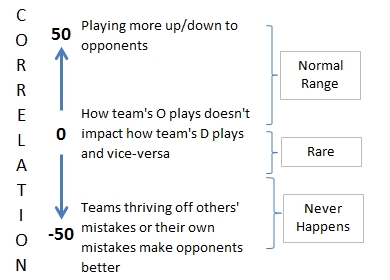
This results from teams' natural variability in performing, both on the offensive side and on the defensive side. Teams aren't fully consistent - they're erratic, playing well sometimes and playing poor other times. What this method also sees, though, is that almost all teams tend to play to the level of their opponents - not all the way, but to some degree. In the underlying method, there is a mathematical term called a correlation that was positive, indicating this correlation. The more positive this number, the more teams played up or down, in general, to their opponents. The closer it gets to zero, the less a team does this. If the number goes negative, then teams actually use their opponents mistakes on defense to make their offense better. Or their own mistakes on one end hurt them on the other end.
A high-intensity press tends to lower that correlation, for example, because it can force turnovers (good defense and good offense) or give up some easy shots (bad defense). Beyond a press, simply forcing a missed shot leads to a defensive rebound (good defense) that is much more likely to turn into transition (good offense) - also negative correlation. This isn't strategy, though, this is just playing well. Teams tend to do that - so why do almost all teams have a positive correlation?
The answer is simply "garbage time," or as Denver Assistant Coach Ryan Bowen once told me, "Show-Me Time," because that's when players like him had to go out there and show the coaches that they deserved their next contract. It turns out that in the rest of the game, or "Normal Time," the correlation between a team's offense and defense is often negative or close to zero, meaning that they do turn good defense into good offense and aren't playing up/down to their opponents. But in garbage, err, Show-Me Time, good teams get bad and bad teams get good. The Warriors of 2016 had the best offense and third best defense in Normal Time, but were 14th best on offense and dead last on defense when the game went to subs because the outcome was decided. (Funny that I don't remember Ryan Bowen talking about playing defense in Show-Me Time.)
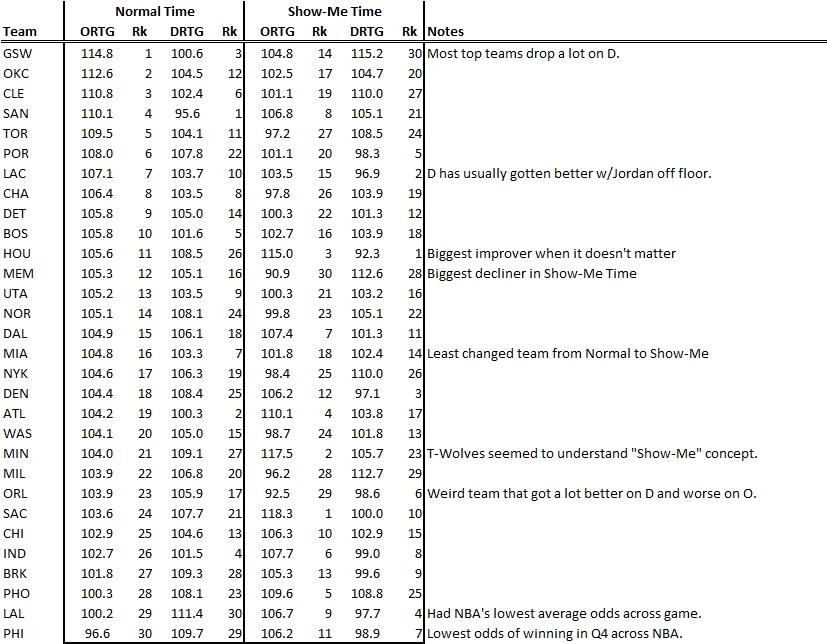
Show-Me Time is what makes it look like teams play up or down to their opponents. These aren't points that lead to wins, they're empty points gained or lost when the chance of winning doesn't change. The best team this year during this period was Houston - the 8th seed in the West after a very disappointing year. The worst team was Memphis, who finished one game ahead of Houston. "Show-Me Time" may matter for the Ryan Bowen's of the league, but it doesn't reflect winning and losing.
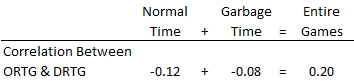
The last thing about this that was interesting was that the correlation between offense and defense in both Normal Time and Show-Me Time was negative. The correlation in Normal Time was about -0.12 and in Show-Me Time about -0.08. Two negative correlations, yet the correlation across entire games was positive at +0.20. Two negatives add up to a positive in a seeming contradiction that only reflects how much the game changes between Normal Time and when Ryan Bowen is trying to show you he can play.
Ryan Bowen had a nice ten year career, so he figured something out.